


 |
| |
 |
| |
 |
| |
 |
| |
 |
| |
 |
| |
 |
| |
 |
| |
 |
| |
 |
| |
 |

 |
| |
 |
| |
 |
| |
 |
| |
 |
 |
| |
 |
| |
 |
| |
 |
| |
 |
| |
 |
| |
 |
| |
 |





 | |  | |  | |  | |  | |  | |  |

| World of James A. Michener -002b- James A. Michener @ "Academy of Achievement": James Michener Biography |

| James Michener Date of birth: February 3, 1907 Date of death: October 16, 1997 James A. Michener was born in New York City. Abandoned at birth, he was adopted by a Quaker widow named Mabel Michener, in Doylestown, Pennsylvania. He never learned the identity of his birth parents. Although his adoptive mother was a poor woman, she shared a love of books and music with her son, and young James Michener became an enthusiastic student. He left home in his teens to hitchhike across the country. The great variety of odd jobs and experiences that followed formed an important part of his early education. He traveled across the land by boxcar, worked in carnival shows, and before he was 20 years old, had visited all but three of the States in the Union. Michener entered Swarthmore College as a scholarship student and graduated with highest honors. He went on to St. Andrew's University in Scotland, and then returned to teach at the George School in Bucks County. There followed two years of "teaching others how to teach," first at Colorado State Teachers College, and then as Assistant Visiting Professor of History at Harvard University. Subsequently, he found himself editing textbooks for a New York publishing firm, a position that was interrupted by World War II, when Michener joined the Navy. |
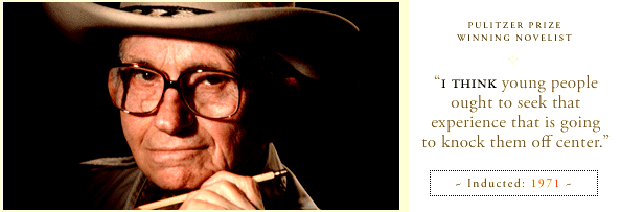


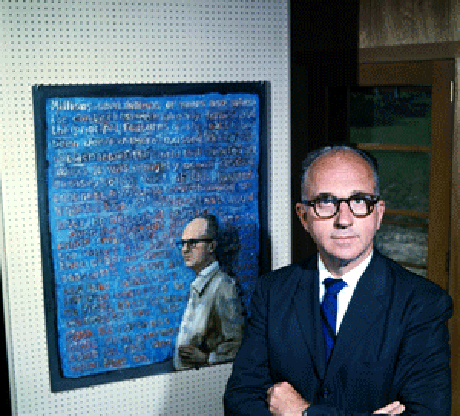
| It was the Navy that introduced Michener to the Pacific. From his wartime experiences in the Solomon Islands came his first book, Tales of the South Pacific, which he mailed anonymously to his former publishing employer. Brought out in 1947, the book won a Pulitzer Prize. Michener won his job back as a textbook editor, and Rodgers and Hammerstein, with Joshua Logan, adapted the story into the musical South Pacific that ran for season after season on Broadway. Michener crossed the Pacific many times. In 1949, he took up residence in Honolulu, Hawaii, and became actively involved in Hawaiian civic affairs. Ten years later, his novel Hawaii was published and became an immediate best-seller. It had been four years in preparation and three in writing, and he finished writing it on the day that Congress voted Hawaii into the Union. James A. Michener traveled widely. In connection with his books and articles, he visited most countries of the world, staying long enough in most of them to become familiar with the customs and to know the people. Michener also explored major themes in numerous books about his homeland. Over his lifetime, he published more than four dozen books, including the texts for five art books. His work has been issued in virtually every language in the world, with hardcover and paperback sales running into the millions. Most of Michener's works are historical novels, all distinguished by the thorough research which is his hallmark. Among these are: The Bridges at Toko-Ri, Sayonara, The Source, Centennial, Chesapeake, The Covenant, Space, Poland, Texas and Alaska. Michener also devoted much of his time to public service. In 1962, he ran for Congress as a liberal Democrat, but lost in a decidedly conservative district. In 1968, he served as secretary of the Pennsylvania Constitutional Convention. From 1979 to 1983, he was a member of the Advisory Council to the National Aeronautics and Space Administration (NASA), an experience that solidified his interest in the field. Other positions included appointments as cultural ambassador to various countries, the advisory committee of the U.S. Postal Service, and the International Broadcasting Board. His many honors and awards include honorary doctorates in five different fields and the Medal of Freedom, the United States' highest civilian award. In 1983, he received an award from the President's Committee on the Arts and Humanities, recognizing his long-standing and continuing support of the arts in America. James Michener was married for 39 years to Mari Yoriko Sabusawa, a second-generation Japanese American, who died in 1994. In his last years, Mr. Michener was based at the University of Texas in Austin, where he died on October 16, 1997, at age 90. |